
A hotel build succeeds or fails long before the first foundation is poured. The feasibility study, the entitlements and the budget all decide the outcome first. The owners who finish on time and on budget usually put design and construction people at the same table from day one, and that is how we work at American Companies. Our design and construction professionals coordinate scope and budget decisions together from the start, and we talk with municipal officials early. This guide walks through the stages, the costs and the decisions that matter most.
Key Takeaways
- Hotel development moves through feasibility, site and entitlements, brand and design, construction, and pre-opening. Approvals are often the longest phase.
- HVS’s 2026 survey, built on 2025 budgets, put median all-in development cost at $213,000 per room. The range runs from about $170,000 for limited-service to $467,000 for full-service.
- Tariffs, financing terms and the three-to-five-year timeline make early budget sensitivity testing essential.
- Design-build unites the architect and contractor as one team. It cuts the handoffs where delays and communication gaps start.
Table of Contents
- What hotel construction involves
- The stages, in order
- What a hotel costs to build
- What moves the budget and the schedule
- Why delivery method decides schedule risk
- How American Companies approaches hotel projects
- FAQ
- Sources
What hotel construction involves
Hotel construction covers the whole path from evaluating a site to handing over a guest-ready property. It includes entitlements and permits, design, procurement, sitework, vertical construction, MEP systems, life-safety compliance, commissioning and the certificate of occupancy. MEP means mechanical, electrical and plumbing. A certificate of occupancy is the local sign-off that the building may legally be used.
The developer starts the project and assembles the team. A project manager, in-house or third-party, coordinates construction, lender inspections and FF&E. FF&E is furniture, fixtures and equipment. The hotel’s general manager, usually the first operator hire, works with ownership on pre-opening.
The stages, in order
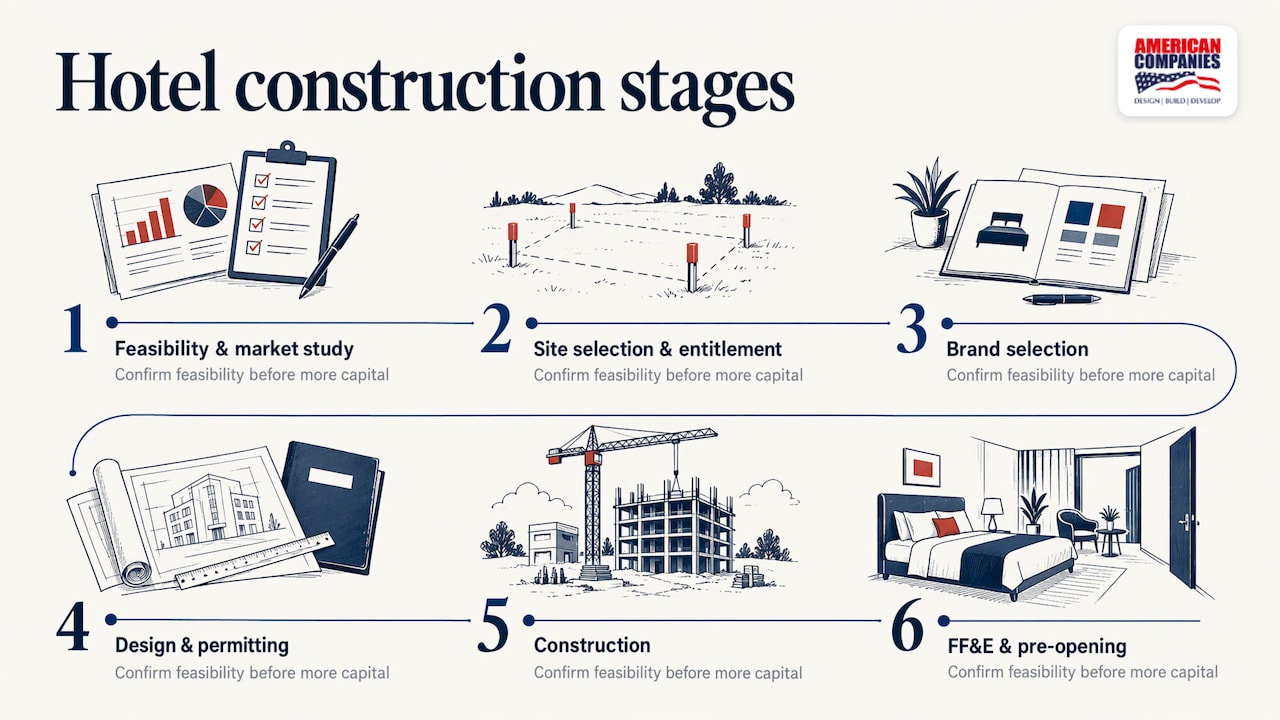
One US guide describes six gated phases: feasibility and market study, site selection and entitlement, brand selection, design and permitting, construction, and FF&E and pre-opening. Each gate should confirm feasibility before more capital is committed.
1. Feasibility and concept
The study tests the market and the numbers. A feasibility study can show that changing room count, quality level or amenities makes a better investment. Lenders also care. They treat hotels as special-use, single-purpose collateral and request a third-party feasibility study on nearly every new build.
2. Site, due diligence and entitlements
Land acquisition calls for Phase I environmental assessments, title clearance, geotechnical investigation and a flood zone determination. Entitlement means zoning approvals, conditional use permits, variances and design review. The same guide says it can take anywhere from 6 months to 3 years, depending on the municipality.
This is where early contact with plan commissions and city staff pays off. A hotel that needs a variance or a conditional use permit is easier to carry through when the site plan, parking, traffic and massing questions have been settled with the city before the hearing. We coordinate with municipal officials early for this reason.
3. Design and permitting
The design must satisfy the Americans with Disabilities Act, the International Building Code as your jurisdiction adopted it, the NFPA 101 Life Safety Code and local fire marshal rules. The 2024 IBC defines Group R-1 to cover transient hotels and motels and lodging houses with more than five guestrooms. Confirm which code edition your city has adopted before design starts.
Brand standards add their own requirements. Bring them into the design early so they don’t force rework in permit review.
4. Construction
A contractor is picked through competitive bid or a negotiated guaranteed maximum price (GMP) contract. Under a GMP, the owner pays actual cost up to an agreed ceiling. Hotels repeat room layouts across floors, which helps efficiency. It also means routine inspections matter, so mistakes are caught before they are duplicated.
5. FF&E and pre-opening
FF&E runs alongside the final construction phase. Vendors for branded product are contracted 12 to 18 months before opening to avoid lead-time delays. Pre-opening timing depends on the hotel. It can start 24 months out for a large, complicated hotel and 4 to 6 months out for a limited-service one. A Marriott opening checklist requires a certificate of occupancy, local operating permits, fire and life-safety acceptance, insurance and completed construction before authorization to open.
What a hotel costs to build
HVS’s 2026 development cost survey, on 2025 budgets, put the median all-in cost at $213,000 per room. All-in means land, hard costs, soft costs, FF&E and pre-opening. The same report gives these medians:
| Hotel type | Median cost per room |
|---|---|
| Limited-service | about $170,000 |
| Midscale extended-stay | about $197,000 |
| Select-service | about $200,000 |
| Upscale extended-stay | about $265,000 |
| Full-service | about $467,000 |
| Luxury | above $1.6 million |
The prior survey, based on 2024 budgets, reported $219,000 per room. HVS says to treat these as a general guide and consult more than one cost source.
A worked example
Take a 100-room select-service hotel at $200,000 per room. That is a $20 million project before any site-specific surprises. Hard costs also vary by city. Gordian’s RSMeans model for a 15-story hotel averaged $261.76 per square foot nationally in 2025, from $227.90 in Orlando to $334.95 in New York. Your market, not the national median, sets your number.
What moves the budget and the schedule
Materials and tariffs. Steel and aluminum tariffs reached 25% in March 2025 and 50% in June 2025, and copper reached 50% in August 2025. The same outlook cites an estimate of roughly 3% on total project cost.
Time. HVS advises adjusting costs for inflation across a typical three-to-five-year development timeline. Material costs change daily, and the gap between analysis and spending can be large enough to change the investment decision. Build a sensitivity range into the pro forma, meaning the projected income and cost statement.
Financing. Lenders typically expect a 5 to 10% contingency reserve on project cost. For small-business hotel loans, SBA SOP 50 10 8, effective June 1, 2025, requires a minimum 10% equity injection on start-ups. Confirm current terms with your lender.
Market timing. LE’s Q3 2026 report put the national pipeline at 5,901 projects and 692,999 rooms, about 5% below a year earlier. STR and Tourism Economics project 2027 US RevPAR growth of 2.7%. RevPAR is revenue per available room. Those figures update each quarter, so check the live releases before you underwrite.
Why delivery method decides schedule risk
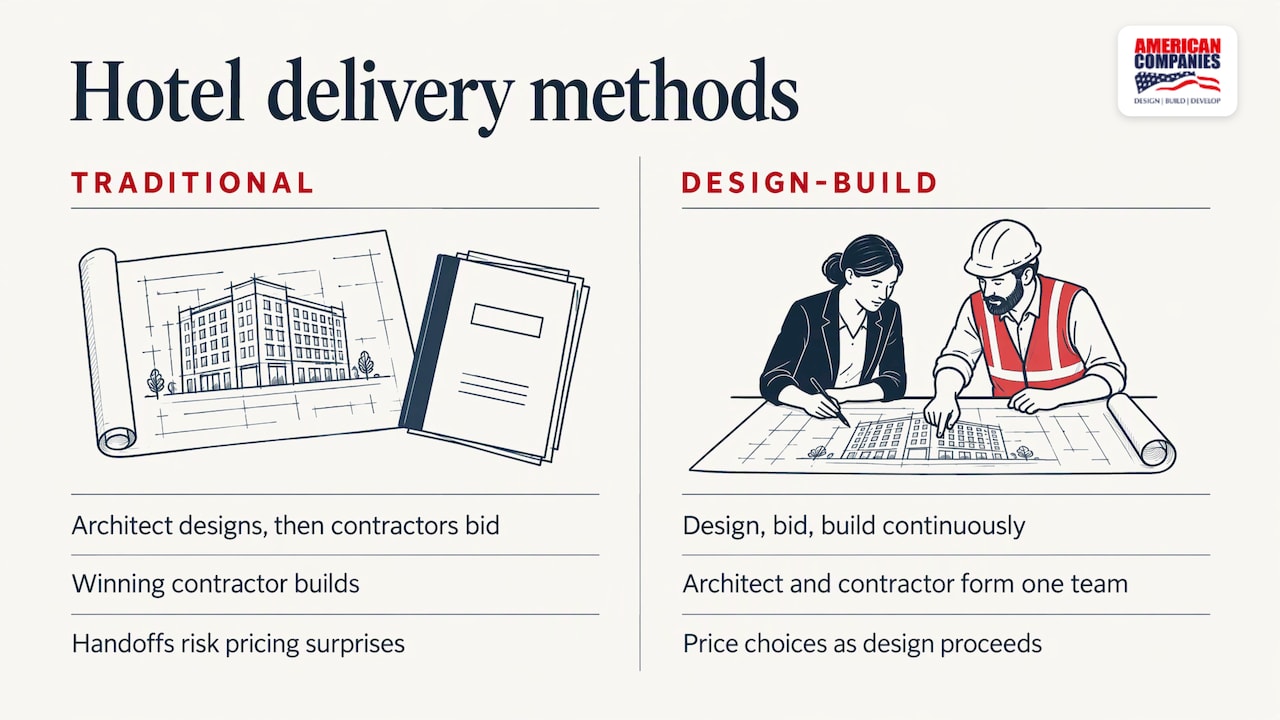
In a traditional sequence, the architect designs, contractors bid and the winner builds. Each handoff can bring pricing surprises and communication gaps. Design-build consolidates design, bid and build into one continuous process and unifies the architect and contractor as a single team. Scope and budget are decided together, so a design choice is priced as it is made.
Project management matters just as much. A flawed concept and poor coordination lead to delays in technical, operational and commercial readiness, so one team should own the schedule from the start. Software that tracks cost codes, scheduling and vendor bids supports this, as the construction software terms glossary explains.
How American Companies approaches hotel projects
American Companies is a family-owned design-build firm founded in 1980. We combine project management with construction, so the people pricing your hotel are the people building it. You get direct communication and personalized project management, and we coordinate early with municipal officials. Our work spans design-build, ground-up construction, additions and renovations, architectural design and construction management and real estate development, acquisition and build-to-suit leases. Our hospitality page covers facility management. Our preconstruction services are where site, scope and budget get settled before ground breaks.
If you are weighing a site or a plan commission hearing for a hotel in the Midwest, start a conversation with us at teamacs.net.
FAQ
How long does hotel development take?
HVS describes a typical development timeline of three to five years. Entitlement alone can run from 6 months to 3 years depending on the municipality. Early coordination with city officials shortens the uncertain part.
How much does it cost to build a hotel?
HVS’s 2026 survey puts the median all-in cost at $213,000 per room, with limited-service near $170,000 and full-service near $467,000. Your site, brand and city will shift the figure, so price your own program.
What codes apply to a new hotel?
The ADA, the International Building Code as adopted locally, NFPA 101 and local fire marshal rules all apply. Your jurisdiction decides which edition governs.
Why use design-build for a hotel?
One team handles design and construction, so scope and budget are coordinated as decisions are made. That reduces the handoffs where schedules slip.
Sources
- Hotel Construction: Planning, Costs and Management, Mews
- The Investment Life Cycle of a Hotel, HVS
- Hotel Development and Construction Process in the US
- Hotel Feasibility Study Consultant for SBA and USDA Loans
- 2024 IBC Significant Changes, City of Prescott
- Marriott Hotel Openings kickoff
- Hotel Construction Guide, Procore
- Hospitality & Gaming, Cumming Group
- HVS US Hotel Development Cost Survey 2025
- Hotel Construction Pipeline 2026, Buildermuse
- Hospitality Market Outlook for SBA Hotel Development
- Hospitality Feasibility: Where ADR Growth Can’t Outrun New Supply
- U.S. Hotel Forecast Assumptions Q4 2026, CoStar
- Why hoteliers should consider a design-build approach, Hotel Dive
- A Project Life Cycle for New Hotels, 4Hoteliers
- Construction Software Glossary